Tunde had been trying to fill a sales manager role for three months. He had posted on LinkedIn, asked for referrals, and even put it out on a WhatsApp group. He got over 200 applications. But every candidate who made it to the final round turned out to be a poor fit. Frustrated, he hired someone quickly just to fill the gap. That person resigned four weeks later.
If that story sounds familiar, you are not alone. Across Lagos, Abuja, and Port Harcourt, founders and HR managers deal with this every week. The recruitment process is broken, not because good candidates do not exist, but because most hiring systems are not built to find them.
This guide covers seven powerful ways to fix your recruitment process in HR, reduce costly hiring mistakes, and build a team that actually moves your business forward.
What Is a Recruitment Process?
A recruitment process is the structured set of steps a company uses to attract, assess, and hire the right candidates for open roles. It covers everything from writing a job description to making an offer and done well, it protects your business from expensive hiring mistakes.
Many Nigerian SMEs operate without a defined recruitment process. Hiring decisions are made based on gut feeling, referrals, or whoever responds fastest. That approach works occasionally, but it fails more often than not.
A structured recruitment process gives you consistency, speed, and better outcomes. It is the difference between hiring in panic mode and hiring with confidence.
Why Your Recruitment Process Is Probably Broken
Here is a hard truth: most small and mid-sized businesses in Nigeria do not have a hiring process. They have hiring habits. And habits are not the same as systems.
Common signs your recruitment process needs work include: roles that take more than six weeks to fill, high turnover within the first 90 days, hiring managers who disagree on what a good candidate looks like, and interview feedback that is entirely subjective.
According to the Society for Human Resource Management (SHRM), the average cost of a bad hire is six to nine months of that employee’s salary. For a business paying N400,000 monthly, that is potentially N2.4 million to N3.6 million lost not counting disruption to your team.
For a deeper look at common hiring mistakes Nigerian businesses make, read our article on the recruitment process in HR and the nine costly mistakes to avoid.
The 7 Powerful Ways to Improve Your Recruitment Process
1. Start with Role Clarity
Before you post a job, get clear on what you actually need. Too many job ads describe a vague ‘rockstar’ or ‘self-starter’ without defining what success looks like in the role. This wastes everyone’s time.
Write a role scorecard instead of a generic job description. Define the top three outcomes you expect the person to achieve in the first six months. Define the skills required, the experience level, and the non-negotiables. When your brief is clear, better candidates apply — and poor fits self-select out.
2. Standardise Your Hiring Stages
Standardisation is not about being rigid. It is about fairness and efficiency. When every candidate goes through the same stages — application review, skills screening, structured interview, reference check, offer — you can make meaningful comparisons.
Without standardisation, two candidates for the same role might have completely different interview experiences. One gets asked tough technical questions; another gets a casual chat. The result? You end up making decisions based on how the interview felt rather than what the candidate can actually do.
Standard Recruitment Process Stages
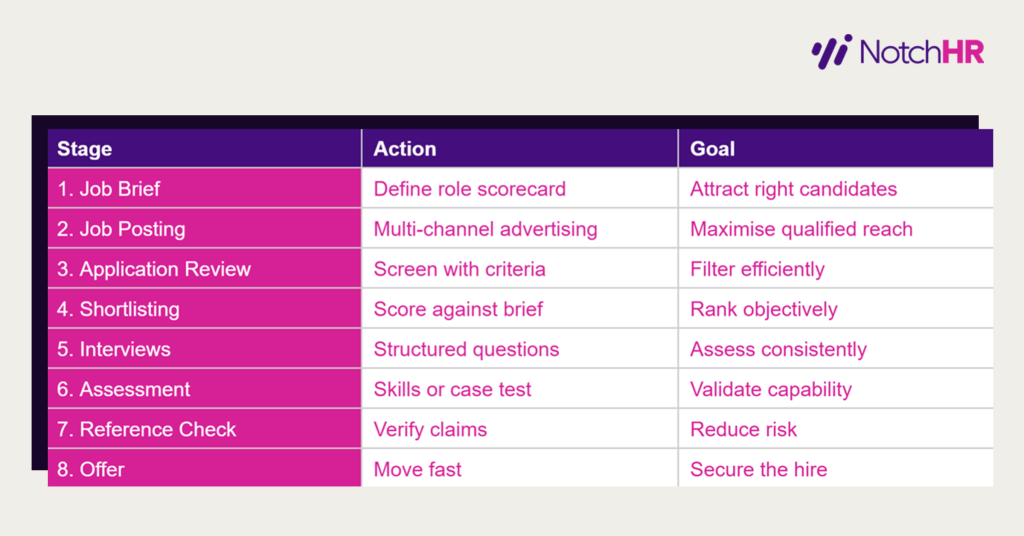
A structured process protects against bias and speeds up hiring decisions. Alt text: Table showing 8 stages of a standardised recruitment process.
3. Use Data to Make Better Decisions
What gets measured gets managed. If you do not track your time-to-hire, offer acceptance rate, or source of best candidates, you are flying blind.
McKinsey research consistently shows that data-driven organisations outperform peers in hiring outcomes. Start simple: track where your best hires come from, how long each stage takes, and how many candidates drop off at each step. Over time, this data tells you exactly where your recruitment process is losing good people.
4. Prioritise Candidate Experience
Nigeria has one of the highest graduate unemployment rates in Africa — yet qualified candidates still turn down offers or ghost employers mid-process. Why? Because the experience of going through your hiring process was poor.
Slow response times, unclear communication, and disorganised interview scheduling all send a message to candidates. That message is: this company does not value your time. Strong candidates have options. Treat every applicant with professionalism, even the ones you reject.
➤ Want to deliver a better candidate experience? Book a demo with NotchHR and see how our recruitment platform streamlines communication from application to offer.
5. Integrate the AI Recruitment Process
Artificial intelligence is changing how companies screen and evaluate candidates. AI tools can scan hundreds of CVs in minutes, flag patterns in candidate data, and even predict role fit based on previous successful hires. This is no longer a tool only large corporations use.
Nigerian businesses that integrate an AI recruitment process are significantly cutting their time-to-shortlist. For a business receiving 500 applications for a single role, AI screening can reduce review time from two weeks to two days. That speed gives you a competitive edge in securing top talent before competitors do.
For a detailed breakdown, read our guide on the AI recruitment process and five powerful benefits it delivers.
6. Automate the Repetitive Recruitment Tasks
Your hiring team should not be spending hours sending acknowledgement emails, scheduling interviews, or chasing references manually. These are recruitment tasks that can be fully automated with the right tools.
Automation frees your team to focus on what actually requires human judgment — evaluating candidates, building relationships, and making final decisions. Platforms like NotchHR’s recruitment software give Nigerian businesses an applicant tracking system that handles the routine work automatically.
To see what is worth automating, read our full breakdown: eight recruitment tasks you can easily automate.
7. Build a Continuous Improvement Plan
A recruitment process is not a one-time setup. It requires regular review. After every major hire, hold a retrospective. What worked? What slowed things down? Where did you almost lose a great candidate?
The best talent acquisition teams treat hiring like a product — always iterating, always improving. A formal recruitment process improvement plan means you get better with every hire, rather than repeating the same mistakes.
See our full guide on building a recruitment process improvement plan with seven proven fixes.
Recruitment Process Tools That Make Hiring Easier
The right tools do not replace good hiring judgment. They support it. Here are the categories of tools that make the biggest difference:
- Applicant Tracking System (ATS): Centralises all applications and tracks candidates through each stage.
- Job distribution tools: Post to multiple job boards with one click, saving hours of manual work.
- Assessment platforms: Skills tests and case studies that give objective candidate data.
- Interview scheduling tools: Remove the back-and-forth emails with self-booking links.
- Analytics dashboards: Show you time-to-hire, source quality, and pipeline health at a glance.
NotchHR’s recruitment platform brings several of these capabilities into one place, designed specifically for Nigerian SMEs and growing teams that need structure without complexity.
Recruitment Tools vs Manual Hiring
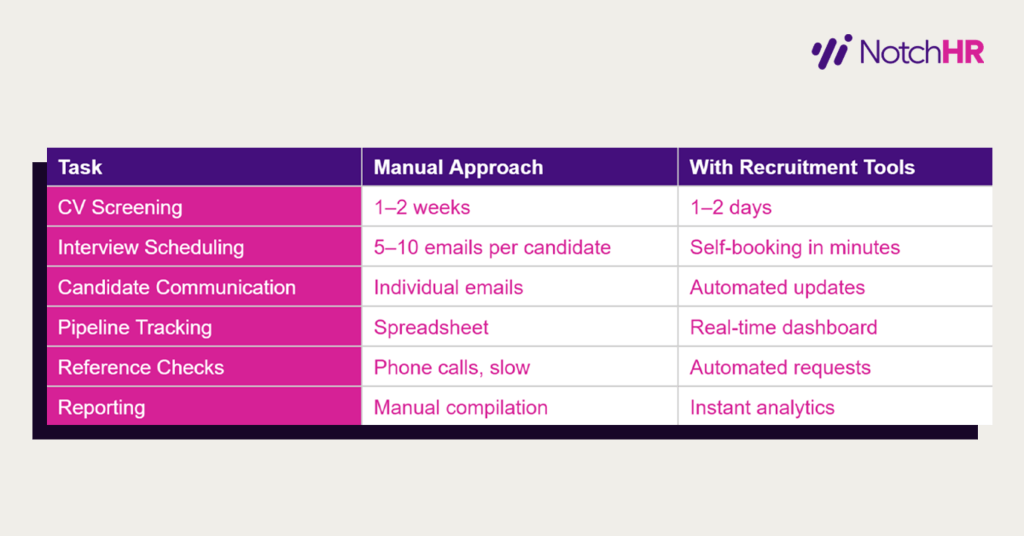
Recruitment tools cut hiring time and improve candidate experience significantly. Alt text: Comparison table of manual hiring vs using recruitment tools.
Final Thoughts
Hiring well is one of the highest-leverage activities a business leader can invest in. Every great team member you bring on multiplies your output. Every bad hire drains it. The recruitment process you run today shapes the business you will have tomorrow.
Start small if you need to. Standardise one stage. Track one metric. Automate one task. Each improvement compounds over time. And as your business grows, so does the sophistication of your hiring system.
NotchHR exists to make this easier for Nigerian businesses at every stage of growth — from the 10-person startup making its first hire, to the 200-person company managing complex talent pipelines.
➤ Ready to hire better? Book a NotchHR demo today and see how a smarter recruitment process looks in practice.
Frequently Asked Questions
Q: How long should a recruitment process take?
A: For most roles, a well-run recruitment process should take between two and four weeks. Senior or specialised roles may take six to eight weeks. If your hiring regularly takes longer than this, it is a signal that your process needs review.
Q: What is the most important stage in the recruitment process?
A: Role clarity — defining exactly what you need before you start — has the biggest impact on final hire quality. Most hiring mistakes happen because the brief was vague, not because the interview was bad.
Q: Can small businesses in Nigeria afford recruitment software?
A: Yes. Tools like NotchHR’s recruitment platform are designed for Nigerian SMEs and priced accordingly. The cost is typically far less than the damage caused by one bad hire or a role left vacant for months.
R
A