M
Introduction: When Payroll Week Becomes a Nightmare
It was a Tuesday morning in Abuja. Racheal, the HR manager at a Smart Energy Company, was staring at her screen with her stomach in knots. Payroll was due by Friday. The company had grown from 52 to almost 100 employees in under two years, and the Excel payroll sheet they had been using since the early days was beginning to show cracks.
Three employees were already waiting outside her office. One insisted his PAYE deduction looked far too high. Another said her pension contribution had not appeared on her payslip for the second month running. A third, a recently promoted field engineer, was confused about why his net pay had dropped when his salary had actually gone up.
Racheal had always been careful. She updated the sheet every month. She cross-checked the figures. But the company had grown faster than her spreadsheet could handle, and the payslip format she had been using was no longer fit for purpose.
Across Nigeria, this exact scene plays out every single month. HR teams issue payslips with missing fields, incorrect PAYE calculations, omitted pension deductions, and net pay figures that do not match bank transfers. The consequences are serious. Employees lose trust. Audits become complicated. The Federal Inland Revenue Service does not accept ignorance as a defence.
The right samples of payslip in Nigeria is not just a nice-to-have document. It is a legal record, a compliance tool, and a communication bridge between an employer and every staff member. This article gives you the full picture. You will find seven proven samples of payslip in Nigeria templates, a breakdown of every statutory deduction, and a clear guide to staying compliant. By the end, Racheal’s Tuesday morning will make a lot more sense. And so will yours.
What Is a Payslip?
When Racheal pulled up her Excel sheet that Tuesday, she could see rows of numbers. What she could not easily see was whether each figure was legally defensible. That is the core problem with an incomplete payslip: it looks like information but does not function like documentation.
A payslip is an official document an employer issues to an employee at the point of salary payment. It summarises what the employee earned, what was deducted, and what was paid out. Every figure on that document should be accurate, transparent, and traceable.
In Nigerian payroll compliance, a payslip does far more than confirm salary. It serves as proof of PAYE remittance, pension contribution, National Housing Fund deduction, and any applicable NHIS contribution. Without a proper payslip, an employee cannot verify their entitlements. An employer cannot defend their deductions during an audit.
The standard payslip sample in Nigeria must reflect both the employment contract and Nigeria’s statutory obligations. These obligations are governed by several regulatory bodies: the Federal Inland Revenue Service for income tax, the National Pension Commission (PENCOM) for pension contributions, the National Social Insurance Trust Fund (NSITF) for workplace injury insurance, the Federal Mortgage Bank for National Housing Fund contributions, and the relevant State Internal Revenue Service for employees working outside the FCT.
This Smart Energy’s payslip, like many Nigerian payslips, captured basic salary and a few deductions. It did not capture all of them. And that gap, however small it seemed, was the source of every complaint sitting outside Racheal’s office door.
Is It Mandatory to Issue Payslips in Nigeria?
After her third employee left that morning, Racheal called her company’s legal adviser. His answer was direct: yes, issuing payslips is effectively a legal obligation in Nigeria, even if the word ‘payslip’ does not appear verbatim in every statute.
The Labour Act of Nigeria requires employers to maintain clear records of wages paid to every employee. The Personal Income Tax Act (PITA) requires that PAYE deductions be properly documented and remitted. Pension regulations under the Pension Reform Act 2014 require that both employer and employee pension contributions be clearly recorded and remitted monthly.
When auditors from the FIRS or a State Internal Revenue Service visit a business, the first thing they request is payroll documentation. A proper payslip format for each employee is the clearest, most auditable record an employer can produce. Without it, the complications multiply fast.
The legal exposure is real. Employers who cannot document PAYE deductions face penalties from the Federal Inland Revenue Service. Employers who cannot show pension records risk sanctions from PENCOM. Those who miss NSITF contributions face enforcement from the National Social Insurance Trust Fund. Employee disputes about deductions are also significantly harder to resolve without written payslip records signed off each month.
Beyond legal risk, not issuing payslips erodes employee trust. Workers who cannot see their deductions will always assume the worst. Racheal’s field engineer did not distrust her intentionally. He just had no document to explain the change. Transparency is not optional in a well-run HR environment.
Key Components of a Payslip Sample in Nigeria
Once Racheal understood the full weight of the obligation, her next question was practical: what exactly should a proper Nigerian payslip contain? She pulled out a notepad and started listing. By the time she was done, she realised her current template was missing at least four mandatory components.
A compliant salary sample of payslip in Nigeria must include five core categories of information. Each one matters. Missing any one creates gaps that trigger employee disputes, audit complications, and compliance penalties.
- A. Employee Information
This section identifies the individual. It must include full name, employee ID or staff number, job title, department, and the pay period being covered. Some organisations also include the employee’s Tax Identification Number (TIN), particularly for senior roles or where FIRS documentation is required.
- B. Employer Information
The company name, address, and employer TIN must appear on every payslip. This grounds the document legally and makes it traceable during audits. For a growing energy company, operating across multiple sites, this employer reference is especially important.
- C. Earnings Breakdown
This section lists all income components before deductions. It typically includes basic salary, housing allowance, transport allowance, medical allowance, leave allowance, and any performance bonuses or commissions. Each item should appear on its own clearly labelled line with the corresponding naira amount.
- D. Statutory Deductions
This is where Nigerian payroll compliance becomes very specific. Every payslip must reflect: PAYE tax calculated under the Personal Income Tax Act, employee pension contribution at a minimum of 8% of monthly emoluments under the Pension Reform Act, National Housing Fund contribution at 2.5% of basic salary for applicable employees, and NHIS contribution where applicable.
Voluntary deductions such as cooperative society dues, loan repayments, or union dues should also appear here, clearly labelled and separated from statutory deductions.
- E. Net Pay Summary
This is the figure every employee looks at first. Gross earnings minus all deductions equals net pay. This number must match the bank transfer exactly. When it does not, you get a field engineer standing outside an HR manager’s office on a Tuesday morning.
Below is a mini sample table showing how these components look in a basic payslip layout:
| Component | Amount (NGN) |
| Basic Salary | 150,000 |
| Housing Allowance | 50,000 |
| Transport Allowance | 30,000 |
| Gross Earnings | 230,000 |
| PAYE Tax | (21,500) |
| Pension (8%) | (18,400) |
| NHF (2.5% of Basic) | (3,750) |
| Total Deductions | (43,650) |
| Net Pay | 186,350 |
Samples of Payslip in Nigeria: 7 Proven Templates
Racheal spent the rest of that Tuesday researching the right payslip format. She needed something that could handle full-time engineers, contract site technicians, and a small commission-based sales team, all under one compliant framework. What she found was that no single template fits every business, but every business fits one of these seven structures.
Here are seven proven templates that cover the full range of Nigerian employment types. Each one is designed to meet compliance requirements while fitting a specific business context. All templates follow the standard format of samples of payslip in Nigeria.
- Template 1: Simple Basic Salary Format
Best for: Small businesses with straightforward salary structures and no variable pay. This is the starting point for businesses that are just getting their payroll format right.
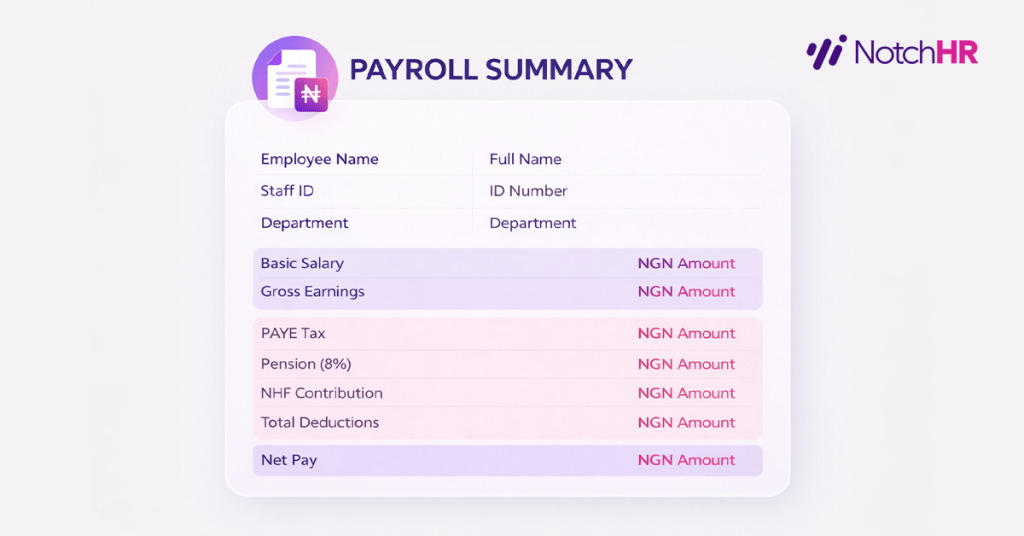
This format works for early-stage companies. Racheal used a version of this for her company when they had fewer than 20 staff. As they grew, it stopped being enough.
- Template 2: Excel Payslip Format
Best for: Growing SMEs that manage payroll manually using spreadsheets and are not yet on a dedicated payroll system.
| Column | Description |
| A: Employee Info | Name, ID, Job Title, Pay Period |
| B: Earnings | Basic Salary, Allowances, Bonuses |
| C: Gross Total | Sum of all earnings columns |
| D: PAYE | Calculated using FIRS-approved tax bands |
| E: Pension | 8% employee contribution of monthly emolument |
| F: NHF | 2.5% of basic salary |
| G: Other Deductions | Loans, cooperative dues, etc. |
| H: Total Deductions | Sum of D + E + F + G |
| I: Net Pay | C minus H |
This was Racheal’s template at her company. It works well up to a point. However, as headcount grows, formula errors become inevitable. Learn how the best payroll software for businesses in Nigeria compares to manual Excel-based approaches before committing to either.
- Template 3: Detailed Allowance Breakdown Format
Best for: Companies with complex compensation structures and multiple allowances, such as energy firms, telecoms, and financial services businesses.
| Earnings Item | Amount (NGN) | Deductions Item | Amount (NGN) |
| Basic Salary | 200,000 | PAYE Tax | 28,500 |
| Housing Allowance | 80,000 | Pension (8%) | 25,600 |
| Transport Allowance | 40,000 | NHF (2.5%) | 5,000 |
| Medical Allowance | 20,000 | NHIS | 3,200 |
| Leave Allowance | 20,000 | Total Deductions | 62,300 |
| Gross Earnings | 360,000 | Net Pay | 297,700 |
This template would have immediately resolved the confusion the organisation promoted engineer experienced. Every allowance is visible. Every deduction is named. Nothing is buried inside a single gross figure.
- Template 4: Commission-Based Payslip Format
Best for: Sales teams, business development staff, or roles with variable monthly income. The solar sales reps needed exactly this format.
| Field | Amount (NGN) |
| Basic Salary | 100,000 |
| Sales Commission (Month) | 85,000 |
| Target Bonus | 20,000 |
| Gross Earnings | 205,000 |
| PAYE (on Gross) | 18,750 |
| Pension (8% of Emolument) | 16,400 |
| NHF (2.5% of Basic) | 2,500 |
| Total Deductions | 37,650 |
| Net Pay | 167,350 |
For commission-based roles, PAYE is calculated on total gross earnings each month. This changes every pay cycle as commission amounts vary. Without a clearly structured payslip format, disputes over net pay are almost guaranteed.
- Template 5: Contract / Temporary Staff Format
Best for: Contract workers, project-based staff, or temporary hires. Energy companies often bring in site engineers and technicians on fixed-term contracts.
| Field | Detail |
| Employee Name | [Name] |
| Contract Type | Fixed-Term / Temporary |
| Contract Period | [Start Date] to [End Date] |
| Pay Basis | Monthly / Daily Rate |
| Agreed Fee / Salary | NGN [Amount] |
| Days/Hours Worked | [Number] |
| Gross Pay (Pro-rated) | NGN [Amount] |
| Withholding Tax (5% or 10%) | NGN [Amount] |
| Net Pay | NGN [Amount] |
| Issuing Entity | [Company Name + TIN] |
Contract and temporary staff may be subject to withholding tax rather than PAYE, depending on their employment classification. Always confirm the correct treatment with your tax adviser or the relevant State Internal Revenue Service.
Template 6: Government-Compliant Structured Format
Best for: Large corporates, regulated industries, and businesses subject to regular audits from FIRS, PENCOM, or other regulatory bodies. As this Smart Energy Company eyes expansion and potential public sector contracts, this format becomes essential.
| Field | Detail |
| Employer Name | [Company Name] |
| Employer TIN | [Tax Identification Number] |
| Employee Name | [Full Name] |
| Employee TIN | [TIN] |
| Grade Level / Step | [HR Classification] |
| Pay Period | [Month / Year] |
| Basic Salary | NGN [Amount] |
| Consolidated Allowances | NGN [Amount] |
| Gross Emolument | NGN [Amount] |
| PAYE (FIRS / SIRS) | NGN [Amount] |
| Pension (8% Employee) | NGN [Amount] |
| Employer Pension (10%) | NGN [Amount – for records] |
| NHF Deduction | NGN [Amount] |
| NSITF Contribution | NGN [Amount] |
| NHIS Employee Share | NGN [Amount] |
| Total Deductions | NGN [Amount] |
| Net Pay | NGN [Amount] |
| Authorised Signatory | [HR / Finance Lead Signature] |
This format aligns with all requirements from FIRS, PENCOM, NSITF, and the National Housing Fund. It is the gold standard for Nigeria payroll compliance and the benchmark all growing businesses should work toward.
- Template 7: Automated Digital Payslip Format (HR Software-Based)
Best for: Businesses with 20 or more employees that need accuracy, speed, and full compliance without the manual error risk that eventually brought Racheal to a standstill.
| Feature | What It Delivers |
| Auto PAYE Calculation | Real-time computation using current FIRS tax tables |
| Pension Auto-Deduction | Calculates and records 8% employee + 10% employer contributions |
| NHF & NHIS | Auto-applied based on employee eligibility |
| Digital Payslip Delivery | PDF payslips sent directly to employee email or HR portal |
| Payroll Audit Trail | Every change is logged with timestamp and user ID |
| Multi-State Tax Support | Handles both FIRS and State Internal Revenue Service requirements |
| Customisable Template | Company logo, branded layout, dynamic fields |
| Compliance Reminders | Alerts for PAYE, pension, and NSITF remittance deadlines |
This was the template Racheal ultimately needed. Not just a better spreadsheet, but a system that removes the manual calculation burden entirely. NotchHR Payroll generates this type of compliant, detailed digital payslip automatically. The system calculates every statutory deduction, applies current PAYE bands, and delivers payslips to employees without manual input. For HR teams managing payroll compliance for Nigerian businesses, this eliminates the single biggest source of error: the human one.
Common Payslip Mistakes African Employers Make
Racheal is not alone. Across Lagos, Abuja, Nairobi, and Rwanda, many African employers are making the same avoidable mistakes when issuing payslips. These mistakes do not happen because HR managers are careless. They happen because the payslip format in Nigeria they are using was never built to handle the compliance requirements of a growing business.
- Wrong PAYE calculation
This is the most common error. Many employers use outdated tax bands or apply flat-rate estimates instead of the graduated rates prescribed by FIRS and the relevant State Internal Revenue Service. A senior engineer on an increased salary could easily end up with a higher gross and a lower net if PAYE is calculated incorrectly. That is exactly the confusion Racheal’s engineer walked in to report.
- Missing pension deductions
This ranks a close second. Under the Pension Reform Act, all employers with three or more staff must deduct 8% from employee emoluments and contribute 10% as the employer share. When this deduction disappears from a payslip, as it had for their second employee, it is not just an administrative error. It is a violation of PENCOM regulations. For a full breakdown of how the current tax law affects these calculations, see the complete guide to Nigeria’s new tax law for HR and payroll teams.
- Incorrect gross salary reporting
Another is widespread issue. This happens when employers exclude taxable allowances from the gross earnings figure to reduce PAYE liability. Every allowance paid to an employee is typically taxable under PITA. Removing allowances from the payslip is both inaccurate and illegal.
- Manual Excel errors
Some errors are invisible until they compound. A wrong formula, a misplaced decimal, or a corrupted column can affect an entire payroll run without anyone noticing until payday. When this happens across 47 employees, the correction process becomes a full-time job for the week.
- Not issuing payslips at all
Thsi remains common among small and early-stage Nigerian businesses. Some founders assume verbal confirmation or a bank transfer description is sufficient. It is not. Every employee deserves a documented, itemised record of their pay. Every employer needs that record in case of an audit.
Each of these mistakes ties directly back to using an inadequate payslip sample in Nigeria. The right template, applied consistently, prevents all of them.
Manual vs Automated Payslip Generation
By Wednesday morning, Racheal had made her decision. She could spend another few hours patching the Excel sheet, or she could solve the problem permanently. She chose to look at automation. Here is the comparison she worked through:
| Factor | Manual (Excel/Paper) | Automated (HR Software) |
| PAYE Accuracy | Prone to formula errors | Auto-calculated from FIRS tables |
| Pension Deduction | Manual tracking required | Auto-applied every pay cycle |
| NHF / NHIS | Easy to overlook | Built into the system |
| Payslip Delivery | Email attachment or printout | Employee self-service portal |
| Audit Trail | No automatic log | Full change history with timestamps |
| Scalability | Difficult above 20 staff | Handles unlimited headcount |
| Time to Run Payroll | 3-5 hours per cycle | Under 30 minutes |
| Error Rate | High with growing teams | Near zero with validated data |
| Compliance Alerts | None | Automated reminders for deadlines |
| Cost | Low initially | Low per-employee cost at scale |
The pattern is clear. Manual payroll made sense when this Smart Energy company had 18 employees. At 96, and growing toward 100, the risk profile had changed completely. NotchHR Payroll is built specifically for Nigerian HR teams at exactly this inflection point. It handles PAYE, pension, NHF, and NSITF compliance in one platform, and delivers branded digital payslips to every employee automatically. No formulas to maintain. No columns to update. No Tuesday morning surprises.
If your payroll situation looks anything like the Smart Energy before Wednesday, book a demo today and see how automation changes everything: Schedule your walkthrough here.
How to Choose the Right Payslip Format for Your Business
Racheal’s situation also raised a broader question: how does any Nigerian business know which payslip format to use? The answer depends on four key factors. Understanding how HR software simplifies PAYE in Nigeria gives a useful starting framework, especially for businesses evaluating whether to automate.
- Company size matters most.
Racheal’s company at 18 staff had different needs from at 94. A sole proprietor with two employees and a company with 250 people on the payroll cannot use the same format effectively. Simple templates work for micro-businesses. Structured or automated formats are essential as headcount grows past 20.
- Staff structure is the next consideration.
The mix of full-time engineers, fixed-term contract technicians, and commission-based sales reps required three different deduction treatments. A team with only full-time salaried employees is simpler. Mixed workforces need a format that can accommodate each classification clearly.
- Payroll complexity grows with every additional allowance type, deduction category, or multi-location arrangement
If your payroll includes variable commissions, site-specific allowances, or employees in multiple states with different SIRS obligations, a detailed or automated format is non-negotiable.
Compliance requirements evolve faster than most HR teams realise.
Nigerian tax law is updated. Pension contribution thresholds change. NSITF rates are revised. A payslip format that was fully compliant 18 months ago may no longer satisfy FIRS today. Automated systems update these parameters automatically. Manual templates require constant human vigilance to keep current.
Growth plans should be the final filter.
If this company expects to reach 100 employees in the next year, building a scalable payroll format now is far cheaper than migrating under pressure later. Choose a format your business can grow into, not one it will quickly outgrow.
Not sure which format is right for your stage? Speak to a payroll expert who understands the Nigerian compliance landscape. A focused 30-minute conversation can prevent months of expensive correction work.
FAQs on Samples of Payslip in Nigeria
What is the standard payslip format in Nigeria?
The standard payslip in Nigeria includes employer and employee details, a full earnings breakdown showing all allowance components, a statutory deductions section covering PAYE, pension, NHF, and NHIS, and a net pay summary. It must also clearly show the pay period and the employer’s TIN. It should be issued to every employee every month without exception.
Is a payslip compulsory by law in Nigeria?
No single law uses the word ‘payslip’ explicitly, but the Labour Act, the Personal Income Tax Act, and the Pension Reform Act all require employers to maintain documented payroll records. Issuing a monthly payslip is the most reliable and auditable way to meet those obligations. Employers who skip this step risk penalties from both FIRS and PENCOM, and face far more complicated employee disputes.
Can I use Excel for payslips in Nigeria?
Yes, Excel is legally acceptable as a payslip format in Nigeria. However, it introduces growing error risk as your team expands. Missed deductions, wrong PAYE calculations, broken formulas, and version control problems are all common with spreadsheet-based payroll. For businesses with more than 10 to 15 employees, a dedicated Nigerian payroll software solution significantly reduces these risks and saves considerable time each month.
What deductions must appear on a Nigerian payslip?
Every compliant Nigerian payslip must show PAYE tax calculated per FIRS guidelines or the relevant State Internal Revenue Service, employee pension contribution at 8% of monthly emoluments, National Housing Fund deduction at 2.5% of basic salary for applicable employees, and NHIS contributions where applicable. NSITF contributions are employer-side but should be reflected in payroll records. Any voluntary deductions, such as loans or cooperative dues, must also be clearly labelled.
How do I calculate PAYE correctly in Nigeria?
PAYE is calculated on consolidated gross emoluments after allowable reliefs: a 20% Consolidated Relief Allowance on gross income, plus a minimum of NGN 200,000 in personal relief. The resulting taxable income is taxed on a graduated scale: 7% on the first NGN 300,000, 11% on the next NGN 300,000, rising to 24% on income above NGN 3,200,000. The full PAYE calculation guide for HR and payroll teams walks through this in detail with worked examples.
Which HR software is best for automated payslips and payroll compliance in Nigeria?
NotchHR is a leading Nigerian HR automation platform built specifically for payroll compliance for Nigerian businesses. It auto-calculates PAYE using current FIRS tax tables, deducts pension and NHF contributions at the correct rates, tracks NSITF obligations, handles multi-state tax requirements, and delivers fully branded digital payslips to every employee. It is exactly the solution Racheal needed: a system that grows with the business, removes manual error risk, and keeps every payslip compliant every month. Explore NotchHR Payroll here, or schedule a walkthrough with the team to see it in action.
Conclusion: The Smart Way to Generate Payslips in Nigeria
By Thursday, Racheal had a plan. By Friday, payroll went out on time. Every employee received a clear, itemised payslip. The PAYE figures were accurate. The pension deductions were present. The promoted engineer finally understood why his net pay had changed, because his gross had increased and with it, his PAYE liability. When he saw it broken down clearly, he nodded and went back to work.
That is the power of the right payslip format in Nigeria. It does not just satisfy a compliance requirement. It communicates with your employees. It protects your business. It creates a paper trail that holds up under audit. And it replaces confusion with clarity.
Racheal’s team at the Smart Energy Solutions eventually moved to an automated payroll system. The Excel sheet that had served them well at 18 employees was retired. Payroll week stopped being a crisis and became routine. That shift did not happen because of one good template. It happened because Racheal understood what a compliant payslip needed to contain and built a system that could deliver it consistently.
You now have all seven templates. You understand what every Nigerian payslip must contain, which regulatory bodies govern each deduction, and what happens when the format falls short. Whether you run a three-person startup in Enugu or a 200-person operation spread across Lagos, Abuja, and Port Harcourt, there is a payslip format in Nigeria here that fits your business. Employee trust starts with transparent, accurate pay, and accurate pay starts with the right payslip.
Do not wait for a Tuesday morning wake-up call. Build the right process today.
Ready to generate fully compliant payslips automatically, every month, without the manual risk? Book a demo with the NotchHR team and see how the platform handles payroll compliance for Nigerian businesses of every size.