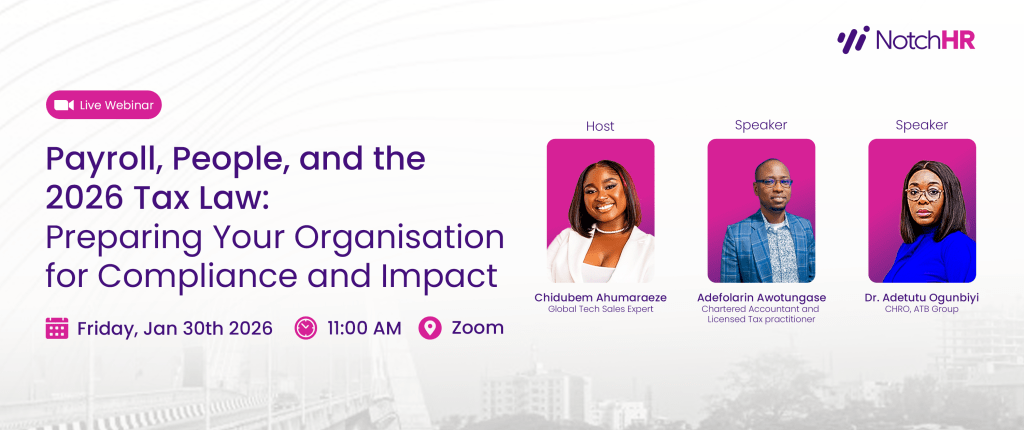
In the last few months, you have probably seen different summaries, tweets, and videos explaining the new tax law in Nigeria. Every explanation sounds different. One HR manager hears that the tax rate for employees has changed. Another hears that some benefits now have new rules. Someone else hears that companies now face a higher compliance burden. The confusion spreads because many people are interpreting the law from second-hand sources instead of reading the actual Nigeria Tax Act 2025.
This leaves HR managers, finance teams, and business owners anxious. You want to stay compliant, but the volume of information is overwhelming. You also know that payroll mistakes can affect employee trust, attract penalties, and expose your company to audits. And with the new tax law in Nigeria taking effect from 1 January 2026, you need clear guidance.
The truth is simple. The new law brings major changes to how income is defined, how companies remit taxes, how benefits are taxed, what counts as deductible, how reliefs work, and how payroll records should be kept.
Here’s the breakdown. You will understand the major updates, the impact on payroll, the calculations, the risks, and the practical steps you must take now. You will also see examples that reflect the Act so that you can align your processes with confidence.
What Exactly Is the New Tax Law in Nigeria
The Nigeria Tax Act 2025 is a single fiscal law that replaces multiple previous tax laws, such as personal income tax, company income tax, capital gains tax, VAT legislation, stamp duties, and several other tax-related laws. The Act brings them under one unified framework so that tax administration becomes more consistent across the country.
The law applies to individuals, companies, trustees, estates, and partnerships. It defines the types of income that are taxable, including salaries, trade income, digital asset transactions, property disposals, and other earnings. It also sets the rules for how companies and individuals should calculate income, what counts as deductions, how to compute profits, how to apply reliefs, and how to determine taxable amounts.
As announced, the law comes into full effect on 1 January 2026. The goal is to improve tax administration in Nigeria, increase clarity, reduce gaps caused by old laws, support digital tax reporting, and strengthen compliance. You will see changes across payroll, employee benefits, documentation, corporate tax responsibilities, withholding tax updates, and the general structure of tax administration in Nigeria.
For HR and payroll professionals, the most important change is how the law restructures personal income tax calculations, introduces new relief allowances, changes how companies are classified for tax purposes, and creates stricter compliance and reporting requirements. Understanding these provisions is critical because mistakes in payroll tax calculations can lead to significant penalties, employee dissatisfaction, and legal exposure for your company.
Key Changes Introduced by the New Tax Law in Nigeria
Updated Personal Income Tax Rates
The new tax law in Nigeria introduces revised personal income tax bands that directly affect how you calculate PAYE for your employees. Under the updated structure, taxable income is now charged at progressive rates across six income brackets.
Taxable Income (₦)
Tax Rate (%)
Notes
0 – 800,000
0
Employees at or below minimum wage pay no tax
800,001 – 3,000,000
15
Next ₦2,200,000 of taxable income
3,000,001 – 12,000,000
18
Mid-level income bracket
12,000,001 – 25,000,000
21
Upper-middle income bracket
25,000,001 – 50,000,000
23
High-income bracket
Above 50,000,000
25
Highest tax rate
This progressive structure means employees in different salary bands will see varying impacts on their take-home pay. Junior staff and minimum wage earners will benefit significantly from the zero tax rate on the first bracket. However, mid-level and senior employees will experience changes based on how their total taxable income falls across multiple brackets.
New Rules for PAYE, Deductions, and Reliefs
The new tax law in Nigeria eliminates the previous Consolidated Relief Allowance and introduces a new rent relief system. Under this provision, employees can now claim 20% of their annual rent paid as a deduction, subject to a maximum of N800,000, whichever is lower. To claim this relief, employees must accurately declare the actual amount of rent paid and provide relevant documentation as prescribed by the tax authority.
Other eligible deductions that reduce taxable income include contributions to the National Housing Fund(NHF), contributions to the National Health Insurance Scheme(NHIS), contributions made under the Pension Reform Act, interest paid on loans used for developing an owner occupied residential property, annual premiums paid for life insurance or deferred annuity contracts for the employee or spouse, and the rent relief mentioned above.
These deductions are applied after gross income has been calculated and certain items have been added back. The order of calculation matters significantly for payroll processing. You must first determine gross employment income, add back any benefits in kind, subtract the eligible deductions listed above, and then apply the progressive tax rates to arrive at the final PAYE amount.
Digital Tax Compliance and Reporting Requirements
The new tax law in Nigeria mandates the use of electronic systems for VAT collection and reporting. Companies are now required to implement fiscalisation systems deployed by the Nigeria Revenue Service. This includes the use of electronic invoicing for all taxable supplies.
For payroll departments, this means adopting or upgrading payroll software to generate electronic tax documents, maintain digital records that can be accessed by tax authorities, submit returns electronically within prescribed timelines, and ensure all PAYE deductions are accurately captured and reported through the electronic system.
The law also requires more detailed reporting of employee information. Employers must now provide comprehensive data on each employee’s gross income, all allowances and benefits provided, statutory deductions made, and net salary paid. This information must be submitted monthly and annually through electronic channels.
Business Taxes That Affect HR and Payroll
The Act updates several company-related taxes that indirectly affect HR operations. Companies that are not small are subject to a thirty per cent company tax. In addition, a minimum effective tax rate applies to companies with large turnovers or entities that are part of multinational groups. If their effective tax rate is below fifteen per cent, they must pay an additional amount to reach the threshold.
There is also a four per cent development levy on the assessable profits of companies except small companies and non-resident companies. This affects payroll planning, especially for budgeting total compensation and cost of employment.
The law also touches withholding tax updates. It clarifies the taxation of partnerships, contractors, joint ventures, trustees, and estates. Many HR teams work with contractors and freelancers, so you must understand how taxable income for these groups is computed.
How the New Tax Law in Nigeria Affects Payroll Processing
Impact on Gross to Net Salary Calculations
Under the new tax law in Nigeria, gross-to-net salary calculations must reflect the revenue categories and relief structures of the Act. Payroll teams must adjust their formulas so that all taxable income is correctly captured. For example, benefits in kind must be valued and included. Allowable deductions must be applied correctly. Pension contributions and similar statutory deductions must follow the Act’s definition.
Because the Act provides a clear framework for what income is, you must classify every payment correctly. Any misclassification affects the final PAYE amount and exposes your company to penalties.
Impact on Employee Take-Home Pay
Employee take-home pay may change under the new tax law in Nigeria if the updated brackets affect their income bracket or if the valuation of benefits changes the taxable portion of their pay. Employees who receive housing, transport, or other benefit packages may see higher or lower PAYE depending on how those benefits fall under the Act.
Employees with digital asset earnings or other side income may also have different tax liabilities. HR teams need to explain these changes clearly so that employees understand why their PAYE changes.
Impact on Payroll Timelines and Documentation
The new tax law in Nigeria increases the need for accurate monthly records. The Act requires proper documentation for relief claims, donations, benefits, research allowances, and deductions. Your payroll documentation in Nigeria must align with these rules.
In addition, because the Act supports improved digital reporting, your payroll timelines must be more consistent. You must maintain detailed monthly calculations, year end summaries, and statutory remittance reports.
Examples of Payroll Calculations Under the New Tax Law in Nigeria
Example 1 — A Mid-Level Employee
A mid-level employee earns a salary and receives a transport allowance. Under the Act, the salary and allowance are part of taxable income. You apply the allowable reliefs, statutory deductions, and then apply the tax brackets to the remaining taxable income. If benefits in kind apply, you must value them according to the rule that ties the valuation to cost or market value.
Example 2 — A Senior-Level Employee
A senior employee receives a salary, benefits, and performance bonuses. All of these count as employment income. Using the Act, you subtract allowable deductions, apply reliefs, and then compute the remaining taxable income through the bracket structure. If the employee has company-provided assets, you must calculate the required percentage of cost or market value and include that amount as a taxable benefit.
Example 3 — Contractor or Part-Time Worker
A contractor is not an employee, but their income is taxable under the rules in the Act that apply to trade or business income or partnership income. The company may need to withhold tax, depending on the nature of the engagement. The contractor must calculate assessable profits after allowable expenses. HR teams must classify contractors correctly to avoid misapplying PAYE rules.
What HR Managers Must Do Immediately
Audit Your Current Payroll Structure
Begin by conducting a comprehensive audit of how your current payroll system calculates taxes. Map out each step from gross salary through to net pay. Identify any elements that will change under the new tax law in Nigeria.
Review employee contracts to understand what benefits you provide. List all housing arrangements, company cars, loans, club memberships, and any other non-cash benefits. Determine how these items should be valued under the new law.
Check whether your payroll software can handle the new progressive tax rates, apply the updated relief allowances, account for benefits in kind correctly, and generate the reports required by the tax authority. If your current system cannot accommodate these changes, you will need to upgrade or switch to a payroll application that is right for you.
Calculate sample payroll runs using the new rates for employees across different salary bands. This will help you understand the financial impact and prepare for questions from staff when the changes take effect.
Update Payroll Software or Switch to a Tax-Compliant Solution
If your current payroll system cannot handle the requirements of the new tax law in Nigeria, you must upgrade or replace it before January 2026. Look for payroll solutions that automatically calculate tax using the new progressive rates, apply all eligible relief allowances, properly value and account for benefits in kind, generate electronic tax returns and schedules, and integrate with the fiscalisation systems required by the Nigeria Revenue Service.
Ensure your chosen solution can handle electronic filing and remittance. The new law mandates digital compliance, which means manual calculations and paper-based processes are no longer adequate.
Test your updated or new system thoroughly before the January implementation date. Run parallel calculations comparing old and new methods. Verify that all employee data migrates correctly and that tax calculations match manual checks for accuracy.
Train Your HR and Finance Teams on Compliance
Your team members need to understand the new tax law in Nigeria and how it affects their daily work. Organise training sessions covering the new tax rates and brackets, how to calculate and apply relief allowances, proper valuation of benefits in kind, electronic filing and remittance procedures, and documentation requirements.
Prepare reference materials that staff can consult when processing payroll. Create quick guides, checklists, and decision trees that simplify complex calculations. This reduces errors and ensures consistency across your team.
Consider whether your team needs external support. Given the complexity of the new law, many companies are engaging tax consultants or legal advisors to provide ongoing guidance during the transition period.
Re-Communicate Salary Changes to Employees Transparently
Employees will notice changes to their take-home pay starting in January 2026. Proactive communication prevents confusion and maintains trust.
Prepare clear explanations of how the new tax law in Nigeria affects different salary levels. Show employees how their gross salary, deductions, and net pay will change. Use specific examples relevant to your workforce.
Hold information sessions where employees can ask questions. HR managers should be prepared to explain why deductions increased or decreased, how the new relief allowances work, what documentation employees need to provide to claim certain reliefs, and when employees will see the changes reflected in their pay.
Provide written summaries that employees can review privately. Many people need time to process financial information and may have additional questions after the initial communication.
For employees whose take-home pay decreases significantly due to higher tax obligations, consider whether your company can adjust salary structures or provide additional benefits to ease the transition. While companies must comply with tax laws, addressing employee concerns demonstrates care and helps maintain morale.
Review Employee Benefits Affected by the New Tax Law
Certain employee benefits now have specific tax treatment under the new law. Review your benefits program to ensure compliance.
If your company provides housing to employees, you must now calculate the annual rental value and include it in their taxable income (capped at 20% of gross salary). Decide whether you will continue this benefit or switch to housing allowances, which are treated differently.
If you provide loans to employees for purchasing or building houses, understand that interest paid on these loans can be claimed as a deduction by the employee. Ensure you provide proper documentation that employees can use when claiming this relief.
Review meal provisions, transportation arrangements, club memberships, and any other benefits. Determine which items constitute taxable benefits in kind and ensure they are properly valued and included in payroll calculations.
Consider restructuring your benefits package to optimise tax efficiency while remaining compliant. For example, certain allowances may be more beneficial for employees than providing direct benefits if those benefits are heavily taxed. Working with your team to understand the policy for hybrid work arrangements can also help you structure compliant and attractive benefit packages.
Common Mistakes Businesses Are Already Making With the New Tax Law in Nigeria
Companies are already misinterpreting parts of the law. Common mistakes include:
Treating some benefits as non-taxable even though the Act classifies them as taxable
applying old personal income tax brackets instead of the new structure
failing to classify digital income properly
ignoring the valuation rules for benefits in kind
using outdated payroll compliance tools
mixing up contractor taxes with employee PAYE
assuming that previous circulars override the new Act
failing to keep the digital records required for audit trails
These mistakes expose your company to penalties and undermine payroll compliance in Nigeria.
Penalties for Non-Compliance Under the New Tax Law in Nigeria
The new tax law in Nigeria provides for significant penalties where companies fail to comply with their obligations.
Where an employer fails to deduct tax from employee salaries as required, the employer becomes liable for the tax that should have been deducted, plus penalties and interest. This means the company must pay from its own funds any tax it failed to collect from employees.
Late remittance of PAYE attracts interest charges. If you deduct tax from employees on time but fail to remit it to the tax authority by the 14th day of the following month, interest accrues on the outstanding amount for each day of delay.
Failure to file returns or filing incomplete returns results in penalties. These penalties increase based on the duration of non-compliance and the amount of tax involved.
Where companies deliberately provide false information, understate income, or manipulate calculations to reduce tax liability, more severe penalties apply. This includes substantial fines and potential criminal prosecution of responsible officers.
Failure to maintain proper records or denying tax officers access to documents during audits also attracts penalties. The law requires companies to cooperate with tax authorities and provide requested information within specified timeframes.
For companies that operate without complying with registration requirements or that conduct business without the required tax identification numbers, penalties include fines and potential closure of business premises until compliance is achieved.
The message is clear: compliance is not optional. The cost of non-compliance far exceeds the cost of implementing proper payroll and tax systems.
Tools, Templates, and Payroll Software That Help With Compliance
Why Automated Payroll Is Critical Now
Manual payroll systems cannot handle digital reporting, strict documentation rules, and valuation of benefits. You need automated tools to avoid the risk of miscalculation, late remittance, or inconsistent records. Audit trails are essential, and only automated tools can create reliable logs without stress.
What a Tax Compliant Payroll System Should Have
A compliant payroll system must include:
automatic application of tax brackets
correct classification of benefits
integration with pensions, housing fund, and health insurance
audit logs
detailed monthly and annual summaries
accurate withholding tax reports
digital payslips and digital storage
automated remittance reminders
compliance dashboard
How NotchHR Helps HR Teams Stay Compliant
NotchHR takes the stress out of adapting to the new tax law in Nigeria. Starting 1 January 2026, all updates from the Nigeria Tax Act 2025 will be automatically applied to your payroll system. HR teams and finance staff do not need to manually adjust tax tables or calculate new brackets. NotchHR implements it for you.
Because the system is fully tax-compliant, every client automatically benefits from the correct PAYE calculations, relief applications, and valuation of benefits in kind. Digital records, statutory deductions, and payroll summaries are updated in line with the law, giving your team confidence that your company is fully compliant without extra effort.
With NotchHR, you can focus on your people while we ensure payroll accuracy, timely remittance, and audit-ready records, so the new tax law works for your business, not against it.
CONCLUSION
The new tax law in Nigeria changes how companies compute taxable income, manage PAYE, classify benefits, and document payroll activities. You must understand these rules now because the law takes full effect from 1 January 2026. With proper systems and clear communication, you can manage the transition easily.
The most important step is to adopt a payroll system that supports accurate calculations, detailed records, and digital reporting. NotchHR gives you the simplest path to compliance.
Do not wait until the last minute. Book a demo today to see how NotchHR can help your business adapt to the Nigeria Tax Act 2025.