In the first week of February, Chioma, an HR Manager at a financial services firm in Lagos, arrived expecting a normal Monday. Instead, her inbox was full and her phone would not stop ringing. January payroll had been processed under the new tax law in Nigeria, and employees were reacting.
Some were confused about higher take-home pay. Others were upset about unexpected reductions. One senior analyst questioned a ₦47,000 drop in net salary, while another colleague received more. The WhatsApp group was already buzzing with speculation that management was playing games with salaries..
Chioma knew about the tax reform. She had read the headlines, attended a brief overview session, and received a memo from the finance team. But knowing it existed and understanding how it worked were two different things. When she called Femi, the Finance Manager, his response was blunt: “We just applied the new bands the tax consultant sent. HR needs to handle the communication.”
But how could she communicate what she did not fully understand herself? Which employees benefited? Why did some lose out? What could she tell people who were already struggling with inflation and rising costs? The new tax law in Nigeria was no longer a policy document gathering dust. It was a live crisis demanding answers she was not equipped to give.
This moment of confusion and urgency is playing out across organisations nationwide. The 2026 tax reform has fundamentally restructured how businesses calculate PAYE, manage compliance, and communicate with employees. Most HR managers know the reform exists, but many do not fully understand how the new tax bands, exemptions, and thresholds affect individual employees or how to respond when staff demand answers. For HR managers and payroll professionals, understanding this shift is no longer optional. It is mission critical.
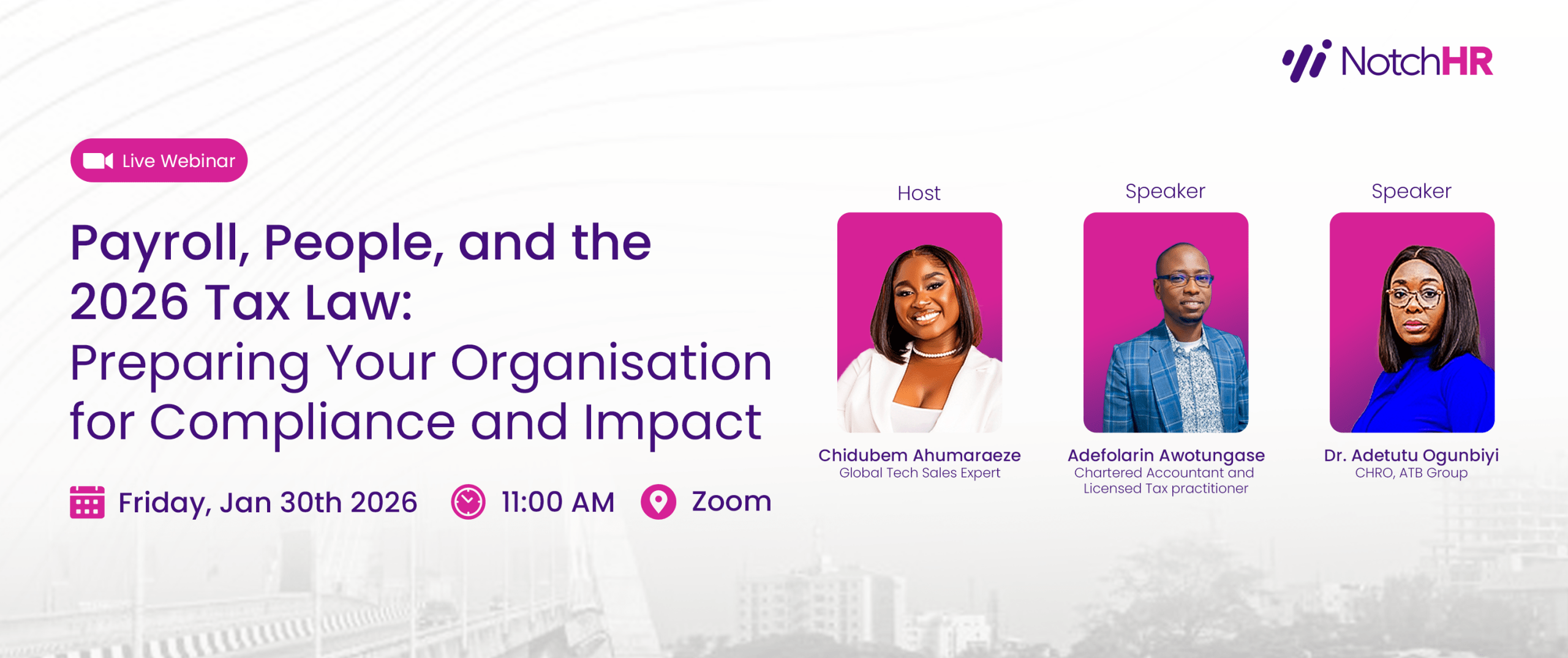
Recognising the scale of this challenge, NotchHR convened a live expert webinar titled “Payroll, People, and the 2026 Tax Law: Preparing Your Organisation for Compliance and Impact.” The discussion featured two leading authorities who unpacked the realities of the new tax law in Nigeria and its direct impact on organisational compliance. If you missed the live session, you can watch the webinar replay on YouTube to follow every insight shared.
Meet the Experts Behind the Webinar Insight
NotchHR assembled a panel of distinguished professionals to decode the reform and equip HR leaders with practical compliance strategies.
Adefolarin Awotungase, a Chartered Accountant and Licensed Tax Practitioner, brought deep technical knowledge of the law of taxation in Nigeria. With extensive experience advising organisations on payroll tax compliance and Nigeria tax system reforms, Adefolarin offered clarity on the statutory obligations now facing employers.
Dr. Adetutu Ogunbiyi, CHRO at ATB Group, provided the HR perspective. Her expertise in change management and employee communication proved invaluable in addressing how organisations can prepare their people, both emotionally and practically, for the shifts in take home pay and tax legislation in Nigeria.
Together, these speakers delivered a comprehensive roadmap for navigating the unified framework introduced by the Nigerian tax reform.
Understanding the New Tax Law in Nigeria (2026 Reform Explained)
The new tax law in Nigeria represents the most significant overhaul of the country’s tax system in decades. Previously, businesses and tax authorities operated under a fragmented system of over 110 separate tax statutes, including the Companies Income Tax Act (CITA), Personal Income Tax Act (PITA), Value Added Tax Act, and Capital Gains Tax Act, each with its own compliance requirements, filing deadlines, and penalties.
The 2026 reform consolidates this complexity into a unified framework governed by four major Acts:
- Nigeria Tax Act (NTA) 2025 – The core statute covering income tax, VAT, and capital gains
- Nigeria Tax Administration Act (NTAA) 2025 – Standardises procedures, enforcement, and taxpayer rights
- Nigeria Revenue Service (Establishment) Act (NRSA) 2025 – Restructures the revenue collection agency
- Joint Revenue Board Act (JRBA) 2025 – Coordinates federal, state, and local tax administration
This consolidation aims to reduce ambiguity, eliminate overlapping levies, and streamline compliance for businesses operating across multiple states. For HR and payroll teams, the most immediate impact comes from changes to Personal Income Tax (PIT) calculations and PAYE obligations.
One of the most notable shifts is the expansion of the tax free income threshold. Under the new tax law in Nigeria, individuals earning ₦800,000 or less annually are now completely exempt from PIT, a significant increase from the previous threshold. This change directly affects how organisations calculate monthly PAYE deductions and communicate net salary expectations to employees.
The reform also introduces clearer definitions of taxable income, standardised tax bands, and stricter penalties for non compliance. For organisations, this means existing payroll processes must be reviewed, updated, and rigorously validated against the new framework.
What the Reform Means for Payroll, PAYE, and Employees
The new tax law in Nigeria fundamentally alters how employers calculate and remit PAYE. While the principle of employer withheld tax remains unchanged, the mechanics including tax bands, exemptions, and filing requirements have shifted in ways that demand immediate operational adjustments.
Under the revised tax bands, many employees will experience changes in their monthly deductions. Low income earners below ₦800,000 annually will see PAYE eliminated entirely, resulting in higher take home pay. However, employees in mid to upper income brackets may face adjustments depending on how the new bands apply to their gross compensation.
For HR teams, this creates both opportunity and challenge. The opportunity lies in communicating tax savings to affected staff, reinforcing the organisation’s compliance posture, and building trust through transparency. The challenge is managing expectations for employees whose net pay may decrease due to band recalibrations or the removal of previous reliefs.
Payroll software must now accommodate the unified framework’s definitions of taxable income, which may include previously excluded allowances or benefits. Organisations relying on manual calculations or outdated systems face significant risk of miscalculation, leading to under remittance and potential penalties.
Additionally, the reform tightens reporting requirements. Employers must now submit detailed monthly PAYE filings that align with the NTAA’s standardised formats. Late or inaccurate submissions can trigger audits, interest charges, and reputational damage.
For organisations managing large or geographically dispersed workforces, the operational burden intensifies. Ensuring that every payroll cycle reflects the correct tax treatment under the new tax law in Nigeria requires robust systems, trained personnel, and continuous monitoring of regulatory updates.
HR’s Expanding Compliance Responsibility
The new tax law in Nigeria does not merely impose technical obligations on finance teams. It places HR squarely at the centre of organisational compliance and employee relations.
HR managers must now navigate a dual mandate: ensuring payroll accuracy while managing the emotional and psychological impact of tax changes on staff. This requires a sophisticated understanding of both the nigeria tax law and effective change management principles.
During the NotchHR webinar, Dr. Ogunbiyi emphasised that compliance is no longer just about numbers. “Change is not only technical. It is emotional,” she noted. Employees experiencing reductions in net pay may feel anxious, frustrated, or distrustful of management. HR’s role is to acknowledge these feelings openly, provide clear information, and create space for dialogue.
This expanded responsibility includes:
- Proactive Communication: HR teams must explain tax changes before they appear on payslips, using simple language and visual aids rather than technical jargon.
- Education and Myth Busting: Many employees wrongly believe management controls tax deductions. HR must clearly distinguish between statutory compliance and discretionary decisions.
- Individual Support: Offering one on one consultations for employees with specific concerns, particularly those in lower income brackets or those significantly impacted by band changes.
- Cross Functional Collaboration: Coordinating with payroll, finance, and legal teams to ensure messaging is accurate, consistent, and reassuring.
The webinar highlighted that organisations failing to invest in this human dimension of compliance risk not only regulatory penalties but also employee disengagement, morale decline, and increased turnover.
Business Risks of Ignoring the New Tax Law in Nigeria
Non compliance with the new tax law in Nigeria carries consequences that extend far beyond financial penalties. While fines and interest charges are the most immediate risks, the broader implications can destabilise operations, damage reputations, and erode stakeholder trust.
Under the NTAA, penalties for late or inaccurate PAYE remittance have been standardised and, in many cases, increased. Organisations that fail to adopt the unified framework’s requirements face:
- Automatic Interest Accrual: Late payments trigger daily interest charges, compounding rapidly for organisations with large payrolls.
- Audit Exposure: Tax authorities now have enhanced powers to conduct detailed payroll audits, demanding documentation that many organisations may struggle to produce.
- Reputational Damage: Public disclosure of tax non compliance can harm relationships with clients, investors, and regulators.
- Operational Disruption: Unresolved tax liabilities can lead to account freezes, restricting an organisation’s ability to pay employees or vendors.
For SMEs, these risks are particularly acute. Smaller organisations often lack dedicated tax or compliance teams, relying instead on external consultants or overextended HR staff. The complexity of the new tax law in Nigeria can overwhelm these resources, creating vulnerabilities that larger firms may navigate more easily.
Moreover, the reform’s emphasis on digital record keeping and real time reporting means that organisations with manual or outdated payroll systems face exponentially higher compliance risk. Paper based processes, spreadsheet driven calculations, and fragmented data storage are no longer viable under the NTAA’s requirements.
The webinar underscored that compliance is not a one time project but an ongoing discipline. Organisations that treat the new tax law in Nigeria as a checklist exercise rather than a fundamental shift in how they manage payroll will find themselves perpetually reactive, firefighting issues rather than preventing them.
Policy Context: What Taiwo Oyedele and Government Officials Have Said About the Reform
Understanding the new tax law in Nigeria requires examining not just the technical provisions but also the policy intent behind them. Taiwo Oyedele, Chairman of the Presidential Committee on Fiscal Policy and Tax Reforms, has been a central figure in shaping and communicating the reform’s objectives.
In multiple public statements, Oyedele has emphasised that the reform aims to simplify Nigeria’s tax system, reduce the burden on low income earners, and improve compliance by eliminating confusion caused by overlapping levies. According to reports, the committee’s work focused on creating a unified framework that businesses could navigate without requiring specialist legal advice for routine transactions.
The decision to raise the tax free threshold to ₦800,000 annually was specifically designed to provide relief to millions of Nigerian workers struggling with inflation and cost of living pressures. This move reflects the government’s recognition that the previous threshold had not kept pace with economic realities.
Business reactions to the reform have been mixed. While some organisations welcomed the clarity and standardisation, others expressed concerns about implementation timelines and the administrative burden of transitioning systems mid fiscal year. Industry groups representing SMEs raised particular concerns about the capacity of smaller businesses to upgrade payroll infrastructure quickly enough to meet the new requirements.
Employee reactions, as reported across social media and workplace forums in January and February 2026, revealed widespread confusion. Many workers did not understand why their net pay had changed, leading to speculation about management misconduct. This disconnect between policy intent and on the ground understanding underscores why HR communication has become so critical.
The Federal Government has also published guidance documents through the Nigeria Revenue Service, outlining transitional arrangements and providing sample calculations for common employment scenarios. However, anecdotal evidence from HR professionals suggests that many organisations either did not access these resources or struggled to translate them into practical payroll adjustments.
For HR managers navigating employee concerns, understanding this broader policy context helps frame conversations. Employees are more likely to accept changes when they understand the reform’s rationale and see that their organisation is complying with a national directive rather than making arbitrary decisions.
Key Insights from the Payroll, People, and 2026 Tax Law Webinar
The NotchHR webinar offered a wealth of practical guidance, distilling complex regulatory language into actionable strategies for HR and payroll teams.
Clarity Before Payroll Impact: One of the session’s core messages was the importance of early, proactive communication. Adefolarin Awotungase emphasised that organisations should explain changes before they appear on payslips, using sample scenarios and visual comparisons.
“When employees can see how the numbers work, uncertainty and fear reduce significantly,” he noted.
Drawing the Line Between Compliance and Discretion: Dr. Ogunbiyi addressed a common misconception that employers control tax deductions. “HR must draw a clear boundary,” she explained. “PAYE is statutory, set by law. The organisation’s role is calculation, deduction, and remittance, not policymaking.” This reframing helps reposition HR from “bearer of bad news” to trusted interpreter of external requirements.
Scenario Based Training for HR Teams: The webinar recommended that organisations invest in focused training sessions that go beyond theory. HR teams should practice responding to questions like, “If an employee earns ₦1.2 million annually, how does their net pay change?” This prepares staff to answer confidently in real time.
Managing Change Fatigue: Recognising that employees are already overwhelmed by inflation and cost of living pressures, the speakers urged HR to pace communication, avoid overload, and emphasise what the organisation can control, such as transparent explanations, budgeting support, and accessible channels for questions.
Addressing Tax Harassment: The webinar also tackled fears about unauthorised levies from local governments. HR should educate employees on legitimate tax demands, establish reporting protocols for harassment, and partner with legal teams to guide affected staff.
For organisations seeking to review the webinar content in full, NotchHR has made the presentation slides available for download. These materials include detailed breakdowns of the tax bands, compliance checklists, and communication templates that HR teams can adapt for their own use.
Additionally, organisations can access the complete webinar replay to hear the expert commentary and Q&A session in full. The recording provides valuable context and practical examples that complement the slide deck.
Immediate Steps Organisations Should Take in 2026
The transition to the new tax law in Nigeria requires deliberate, sequenced action. Organisations cannot afford to wait for the first compliance deadline or payroll cycle to begin addressing the reform’s requirements.
Step 1: Audit Current Payroll Processes
Begin by reviewing how your organisation currently calculates PAYE, files returns, and maintains records. Identify gaps between existing practices and the NTAA’s requirements, particularly around digital documentation and monthly reporting.
Step 2: Update Payroll Systems
Ensure your payroll computer software reflects the new tax bands, exemptions, and filing formats. If your system cannot accommodate the unified framework, transition to a solution that can. Manual or spreadsheet based calculations are no longer viable.
Step 3: Train HR and Payroll Teams
Invest in comprehensive training that covers both the technical aspects of the nigeria tax law and the communication skills needed to support employees. Scenario based learning is essential.
Step 4: Communicate Early and Often
Do not wait until payroll processing to inform employees of changes. Use town halls, FAQs, sample payslips, and one on one sessions to prepare staff for what is coming.
Step 5: Establish Cross Functional Coordination
Align HR, payroll, finance, and legal teams to ensure consistent messaging and accurate execution. Designate a compliance lead responsible for monitoring regulatory updates and coordinating responses.
Step 6: Plan for Ongoing Monitoring
Compliance is not static. Assign responsibility for tracking legislative amendments, tax authority guidance, and industry best practices. Schedule quarterly reviews to ensure continued alignment with the new tax law in Nigeria.
If your organisation is unsure how to implement these steps effectively, speak to one of NotchHR’s consultants who can provide tailored guidance based on your specific payroll setup and workforce structure.
Common Payroll and Compliance Mistakes to Avoid
Even well intentioned organisations fall into predictable traps when navigating major tax reforms. Awareness of these pitfalls can help HR and payroll teams avoid costly errors.
Mistake 1: Treating Compliance as a One Time Event
Tax reform is not a project with a defined end date. Organisations that update systems once but fail to monitor ongoing changes will quickly fall out of compliance.
Mistake 2: Relying on Outdated Payroll Software
Systems that cannot accommodate the unified framework’s requirements create risk. Manual workarounds and spreadsheet overrides introduce errors and audit exposure.
Mistake 3: Underestimating Communication Needs
Technical accuracy means nothing if employees do not understand it. HR teams that skip proactive communication will face confusion, distrust, and morale issues.
Mistake 4: Failing to Document Compliance Efforts
The NTAA requires robust record keeping. Organisations that cannot demonstrate how they calculated deductions, filed returns, or responded to employee queries face penalties during audits.
Mistake 5: Ignoring Employee Well Being
Tax changes can cause financial stress, particularly for employees already struggling with inflation. HR teams that fail to acknowledge this reality and offer support where possible risk disengagement and turnover.
Mistake 6: Delaying System Upgrades
Procrastination on payroll system modernisation compounds risk. The longer organisations wait to adopt compliant tools, the more manual effort and error exposure they accumulate.
For more insights on navigating payroll management mistakes and avoiding common errors, NotchHR’s blog offers detailed guidance tailored to Nigerian organisations.
Why Payroll Automation Matters More Than Ever
The new tax law in Nigeria has rendered manual payroll processes obsolete. The complexity of the unified framework, combined with tightened reporting requirements and penalties, demands automation as a matter of survival, not convenience.
Automated payroll systems offer several critical advantages:
Accuracy at Scale: Software eliminates the calculation errors inherent in manual processes, ensuring that every employee’s PAYE deduction reflects the correct tax band, exemptions, and relief.
Real Time Compliance: Modern platforms update automatically when tax rates or regulations change, reducing the risk of applying outdated rules.
Audit Ready Documentation: Automated systems generate and store the detailed records required by the NTAA, making audits faster and less disruptive.
Employee Transparency: Digital platforms often include self service portals where employees can view their tax calculations, reducing HR’s administrative burden and improving trust.
Efficiency Gains: Automation frees HR and payroll teams from repetitive tasks, allowing them to focus on strategic activities like change management and employee support.
The transition from manual to automated payroll is not without challenges. Organisations must invest in software selection, data migration, and staff training. However, these upfront costs pale in comparison to the ongoing risk and inefficiency of maintaining outdated processes.
For organisations evaluating options, NotchHR’s blog provides a comprehensive guide to selecting the best payroll software for businesses in Nigeria, covering features, pricing, and implementation considerations.
Additionally, understanding the challenges of payroll processing can help organisations anticipate obstacles and plan mitigation strategies.
Looking ahead, the future of payroll computer software points toward increased integration with PAYE systems, real time tax authority reporting, and AI driven error detection—capabilities that will become table stakes as the nigeria tax system continues to evolve.
How NotchHR Helps You Stay Compliant with the New Tax Law in Nigeria
Navigating the 2026 tax reform requires more than good intentions. It demands purpose built tools and expert support. NotchHR’s payroll platform is designed to help Nigerian organisations achieve full compliance with the new tax law in Nigeria while reducing administrative burden and improving employee experience.
Automated PAYE Accuracy: NotchHR’s system automatically applies the correct tax bands, exemptions, and reliefs defined by the NTA, eliminating manual calculation errors and ensuring every payroll cycle reflects current law.
Compliance Ready Payroll Processing: The platform generates the standardised monthly filings required by the NTAA, complete with the documentation needed to survive tax audits. Built in validation checks flag potential issues before submission, preventing costly mistakes.
Reduced Manual HR Workload: By automating payroll calculations, tax filing, and record keeping, NotchHR frees HR teams to focus on what matters most: supporting employees through change and building organisational resilience.
Transparent Employee Deductions: Employees can access detailed breakdowns of their tax calculations through secure self service portals, reducing confusion and the volume of HR inquiries.
Alignment with Unified Tax Framework: NotchHR continuously monitors regulatory updates and implements system changes proactively, ensuring organisations remain compliant as the nigeria tax law evolves.
For organisations ready to modernise their payroll operations and eliminate compliance risk, exploring NotchHR’s payroll solution is a practical first step.
Conclusion – Preparing for a Compliant Payroll Future
The new tax law in Nigeria is not a distant policy change. It is a present operational reality demanding immediate attention from every HR and payroll team. The shift from 110 fragmented statutes to a unified framework creates both opportunity and obligation.
Organisations that approach this reform strategically by investing in automation, training their teams, and prioritising transparent employee communication will emerge stronger, more efficient, and better positioned for future regulatory changes.
Those that delay, relying on outdated systems and reactive responses, will face mounting compliance risk, employee dissatisfaction, and operational strain.
The NotchHR webinar made clear that success in this environment requires more than technical compliance. It demands empathy, clarity, and a commitment to supporting employees through change. HR managers like Chioma, fielding anxious calls and emails in February, deserve tools and guidance that make their jobs manageable rather than overwhelming.
The path forward begins with education, continues with investment in the right systems, and is sustained through ongoing vigilance. Nigeria’s payroll compliance landscape has changed permanently. Organisations that adapt now will thrive. Those that do not will struggle.
If you are unsure how to implement the new tax law in Nigeria within your payroll system or need expert guidance on compliance, speak to one of NotchHR’s consultants who can walk you through the technical and operational requirements specific to your organisation.
Frequently Asked Questions
What is the new tax law in Nigeria (2026)?
The new tax law in Nigeria consolidates over 110 separate tax statutes into a unified framework governed by four major Acts: the Nigeria Tax Act (NTA), Nigeria Tax Administration Act (NTAA), Nigeria Revenue Service (Establishment) Act (NRSA), and Joint Revenue Board Act (JRBA). This reform standardises Personal Income Tax calculations, PAYE obligations, and compliance procedures nationwide.
How does the new tax law affect PAYE deductions?
The reform raises the tax free income threshold to ₦800,000 annually, completely exempting low income earners from PIT. It also introduces revised tax bands that may increase or decrease PAYE deductions for mid to upper income employees, depending on their gross compensation and applicable reliefs.
What are the penalties for non compliance with the new tax law in Nigeria?
Penalties include automatic interest accrual on late payments, enhanced audit powers for tax authorities, potential account freezes, and reputational damage from public disclosure of non compliance. The NTAA standardises and increases penalties compared to the previous fragmented system.
Do I need to update my payroll software for the 2026 tax reform?
Yes. Payroll systems must reflect the new tax bands, exemptions, and monthly filing formats required by the NTAA. Manual or outdated systems create significant risk of calculation errors and non compliance.
How should HR communicate tax changes to employees?
HR should communicate early, before changes appear on payslips, using simple language and visual examples. Provide sample payslips comparing “before” and “after” scenarios, establish clear channels for individual questions, and acknowledge the emotional impact of net pay changes.
What steps should my organisation take immediately?
Audit current payroll processes, update payroll systems to reflect the unified framework, train HR and payroll teams, communicate changes proactively to employees, establish cross functional coordination, and plan for ongoing regulatory monitoring.
Where can I learn more about the 2026 tax reform?
NotchHR hosted an expert webinar titled “Payroll, People, and the 2026 Tax Law: Preparing Your Organisation for Compliance and Impact.” The webinar slides and replay are available for organisations seeking detailed guidance on implementing the reform effectively.